







Hey friend, can I tell you about the moment I realized I'd been overthinking my art?
I was standing in front of my palette with probably 20 colors squeezed out, staring at a blank page, totally frozen. Too many options. Too many directions I could go. So I did something a little wild. I grabbed just three paints, closed the rest, and told myself, “This is all you get.”
That one decision turned into one of my favorite exercises I come back to again and again. And today, I'm walking you through the exact same painting challenge so you can try it yourself.

Why a Limited-Palette Painting Challenge Sparks Creativity
Here's the thing most people don't expect: having fewer choices actually makes creating easier. When you sit down with a full palette, your brain has to sort through a ton of decisions before you even touch the paper. Which colors? What combination? What if I pick wrong?
A painting challenge that limits your palette strips all of that away. You pick three colors, and that's it. No second-guessing. No spiraling. Just you, your brush, and three paints.
And here's what I love most about this. When you take away options, your creativity has to show up differently. You start problem-solving. You start mixing colors you never would have tried. And you surprise yourself.
This isn't about making a perfect painting. It's about giving yourself a low-pressure way to experiment and play. Because some of the best creative breakthroughs come from working within boundaries, not outside them.
The Simple Rules of the Limited-Palette Painting Challenge
This painting challenge is meant to be simple. No complicated setup, no fancy supplies. Here are the basic rules:
- Choose only 3 colors (any three you want)
- Pick one composition or subject to paint
- No sneaking in extra colors halfway through (I know, it's tempting)
- Set an optional time limit of 15 to 30 minutes to keep things loose
- Use watercolor supplies you already own
That's it. Seriously. You don't need to buy anything new or prepare anything special. Just grab what's on your desk and start.
If you're not sure what supplies to use, I've got a full list of my favorite watercolor supplies that I personally use and love.

How to Choose Your 3 Colors (Without Overthinking It)
Okay, picking three colors can feel like a big decision, but I promise it doesn't have to be. Here are a couple of easy starting points:
- One warm, one cool, one neutral. Think something like a red, a blue, and a brown or gray. This gives you a natural range to mix from.
- Two colors plus one “bridge” color. Pick two colors you love, then choose a third that can blend well with both.
From there, you can experiment with different vibes:
- Moody palettes: Deep blues, earthy greens, and burnt oranges
- Soft palettes: Pale pinks, light yellows, and lavenders
- High-contrast palettes: A bold red, a deep indigo, and a bright yellow
There is genuinely no wrong combination here. That's the whole point. Part of this painting challenge is letting go of “right” and just seeing what happens. You might end up with a color combo you never would have picked on purpose, and it might become your new favorite.
Not sure which colors to start with? My guide to building your own watercolor palette breaks down warm and cool primaries and how to mix them. It's a game-changer.
Choosing One Composition to Paint Again and Again
This is where the painting challenge gets really fun. You're going to pick one subject and paint it multiple times using different three-color combos.
Why? Because repeating the same composition lets you focus entirely on how color changes the mood of a piece. Same shapes, same layout, completely different feeling.
Here are some easy composition ideas to start with:
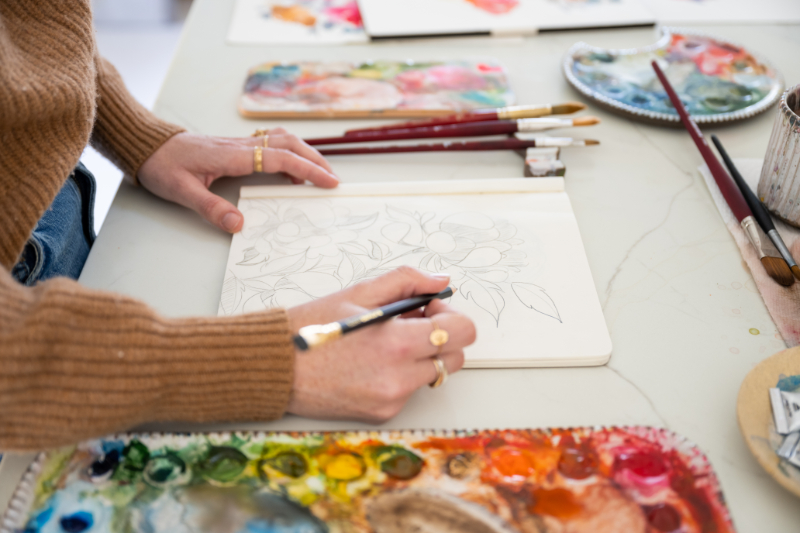
- A simple flower (loose is great, no need for detail)
- A small landscape with a sky and horizon line
- A still life object like a mug or a piece of fruit
- A loose shape or abstract form
Stuck on what to paint? I have a ton of beginner ideas on my YouTube channel to get you started.
If you want to try this with a landscape, I actually have a YouTube tutorial where I paint watercolor clouds and a landscape using only three paints. It's a great companion to this painting challenge and shows you just how much range you can get from a tiny palette.
What to Pay Attention to During the Painting Challenge
While you're painting, try to stay curious about what's happening on the page. Here are a few things worth noticing:
- Color mixing surprises. When you only have three pigments, you'll start creating secondary and tertiary mixes you didn't plan. Some of them will be gorgeous.
- Value shifts. Pay attention to how light and dark your mixes get. You can create a wide value range with just three colors by adding more water or layering pigment.
- Natural harmony. With a limited palette, your painting will automatically feel more cohesive. The colors just work together because they have to.
- Unexpected contrast. Notice where your lightest and darkest areas land. Even without a huge color range, contrast will show up in ways that give your painting depth.
This is where watercolor techniques like wet on wet painting and layering really shine. With fewer colors to manage, you can focus on how the paint moves and how your brushstrokes interact with the water.
Common Struggles You Might Feel (Totally Normal!)
Let me be real with you. This painting challenge can feel a little uncomfortable at first. Here's what might come up:
- The urge to “just add one more color.” You'll feel it. Resist it. That constraint is the whole exercise.
- Feeling bored or restricted. This usually passes once you start mixing and seeing unexpected results on the paper.
- Paint not behaving how you expected. Some three-color combos will mix into muddy tones. That's not failure. That's information.
When any of these feelings pop up, try to stay curious instead of judgmental. Ask yourself, “What can I learn from this?” instead of “Why doesn't this look good?” That shift makes all the difference.
If you're newer to watercolor and want a solid foundation to build on, my free beginner's guide e-book covers everything from basic watercolor techniques to color theory. It's a great place to start before diving into challenges like this one.
What This Limited-Palette Painting Challenge Teaches You
Even though this exercise is simple, what it builds in your art practice is anything but. Here's what you'll walk away with:
- Stronger color-mixing skills. When you can't reach for a pre-made green or purple, you learn to mix your own. That skill carries into every painting you make after.
- Better value awareness. Working with fewer colors forces you to think about light and dark, which is one of the most important foundations in painting.
- More cohesive paintings. A limited palette naturally creates color harmony, and once you see how that works, you'll start applying it to bigger pieces.
- More confidence with fewer supplies. You'll realize you don't need 40 tubes of paint to make something beautiful. Three will do just fine.
If you want to keep building these skills, The Art Within goes deep into fundamentals like color, composition, and finding your personal art style. It's like going to art school from your kitchen table.

Take the Limited-Palette Painting Challenge Further
Once you've tried this painting challenge once, I hope you'll come back to it. Here are some ways to keep it fresh:
- Try it on different days when you're in different moods. Your color choices and energy will shift, and so will the results.
- Use the same three colors but switch to a totally new subject.
- Try the same subject and same colors, but change your watercolor techniques. Go loose one day, more detailed the next.
This is one of those exercises that meets you wherever you are. Whether you're a total beginner or you've been painting for years, a limited-palette painting challenge will teach you something new every single time.
So grab three colors, pick a simple subject, and see what happens. I think you'll surprise yourself.And hey, if you want more creative nudges like this delivered straight to your inbox, come join my email list. I share tutorials, tips, and a whole lot of encouragement every week. Let's be friends!










+ show Comments
- Hide Comments
add a comment