






A camera captures what you saw. A watercolor travel journal captures what it felt like to be there. And that's a completely different thing.
I've led painting retreats in France, Morocco, Spain, Italy, and Portugal. Places like a Tuscan estate with views of San Gimignano, a Spanish private estate tucked into Andalucía's first UNESCO Biosphere Reserve, and a Portuguese quinta overlooking the Atlantic coastline. Every sketchbook filled on those trips tells a story that no photo could.
One thing I see every single time is this: people arrive worried they're not ready. Then they open a sketchbook, put paint on paper, and something changes. The journal they fill that week becomes one of their most treasured things from the trip. Not the photos. Not the wine (well, maybe tied with the wine).
Here's the thing: you don't need to be on a retreat to paint your travels. You just need a sketchbook, a small kit, and permission to paint imperfectly. That's actually the whole point. This post covers what to pack, how to set up your watercolor travel journal, what to paint by destination type, and how to keep the whole thing fun.
No experience needed. Loose, expressive, imperfect paintings make the best travel journals.
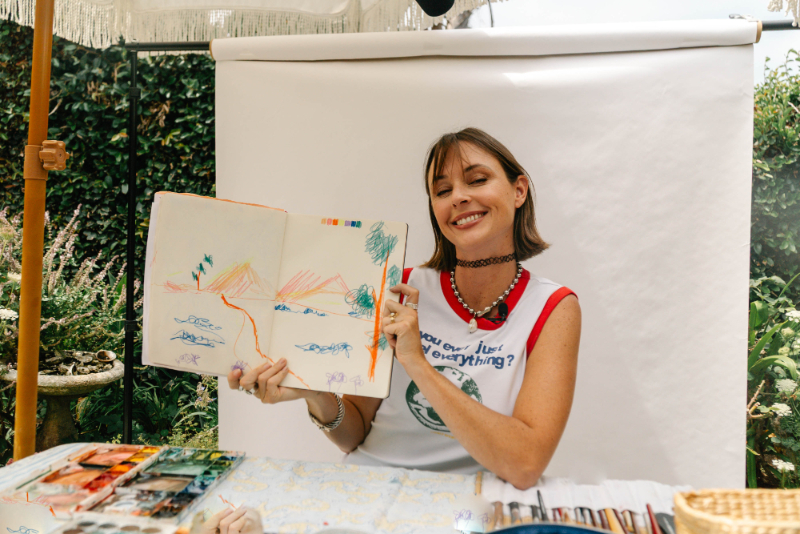
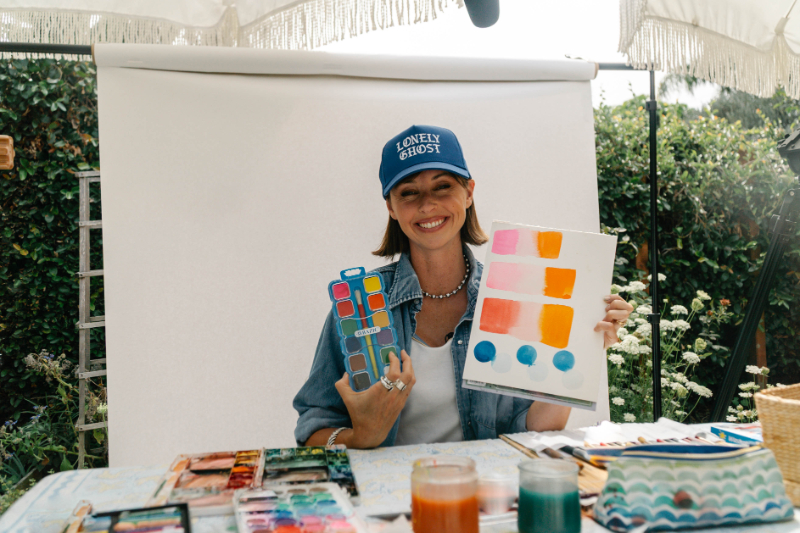
Hey friend, I'm Jenna Rainey!
I’m a self-taught watercolor artist, best-selling author, and someone who is completely hell-bent on teaching everyone how to find their inner creative voice. I teach through YouTube, online courses, books, and in-person retreats around the world. If you're brand new to watercolor, my free Complete Beginner's Guide to Watercolor e-book is the best place to start before you do anything else.
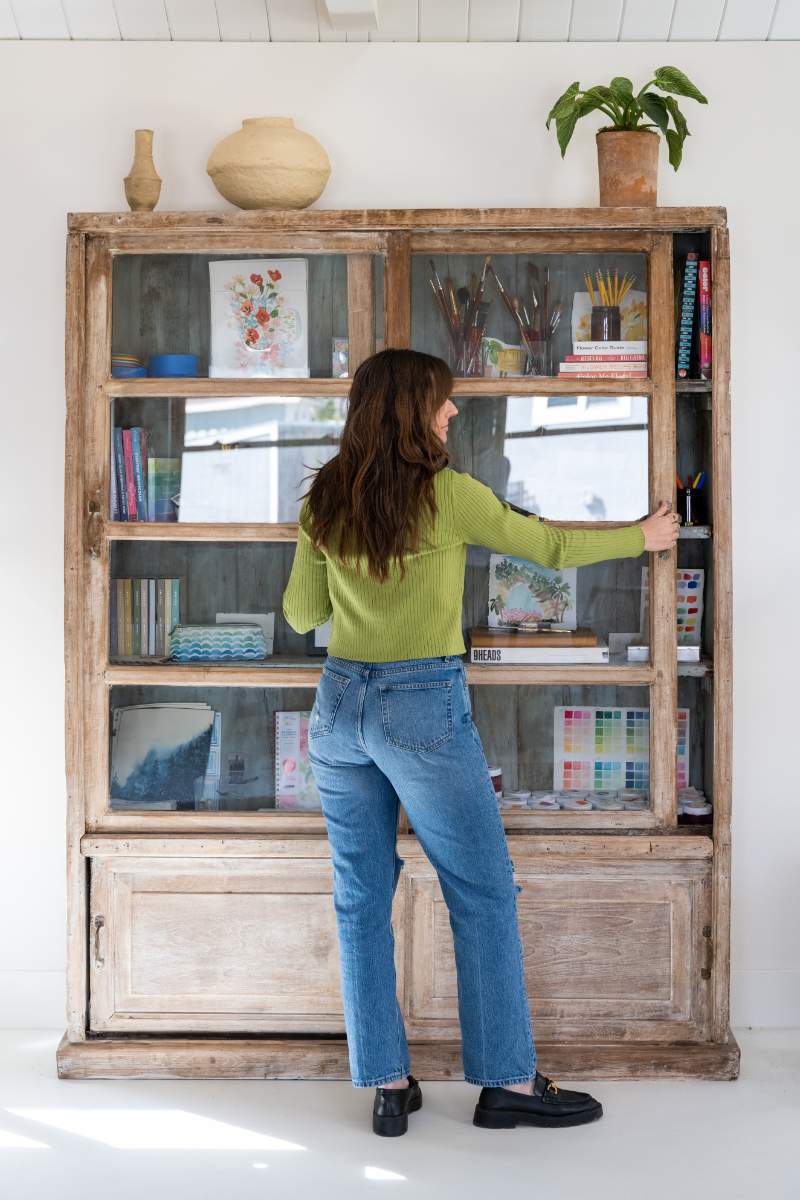
Why a Watercolor Travel Journal Beats Any Other Souvenir
Watercolor is the most portable fine art medium there is. A travel palette, a sketchbook, and two brushes fit in a carry-on pocket. That alone makes it worth considering.
But the real reason to keep a watercolor travel journal is what happens when you sit down to paint a place. You slow down and actually look at it. You notice the specific blue of a Mediterranean door. The warm gold of afternoon light on stone. The exact way a palm tree bends against the sky. Tourists walk past that stuff. Painters stop and stare at it.
Your paintings also become memory anchors in a way photos aren't. You made them. You mixed those colors, held that brush, felt the heat or the breeze while the paint was wet. Flip through that sketchbook three years later and you're right back there.
And honestly, it builds a kind of confidence in your painting that's hard to get any other way. When you're painting from life, with a limited kit and a time constraint, you stop overthinking and start responding. The constraints do the work for you.
If you want that experience with a fully guided creative travel program around it, I do lead art retreats a few times a year in locations that are basically made to be painted.
What to Pack: Your Minimalist Travel Kit
This is one of the most common questions I get when people want to start painting outdoors. Here's exactly what I bring.
The non-negotiables:
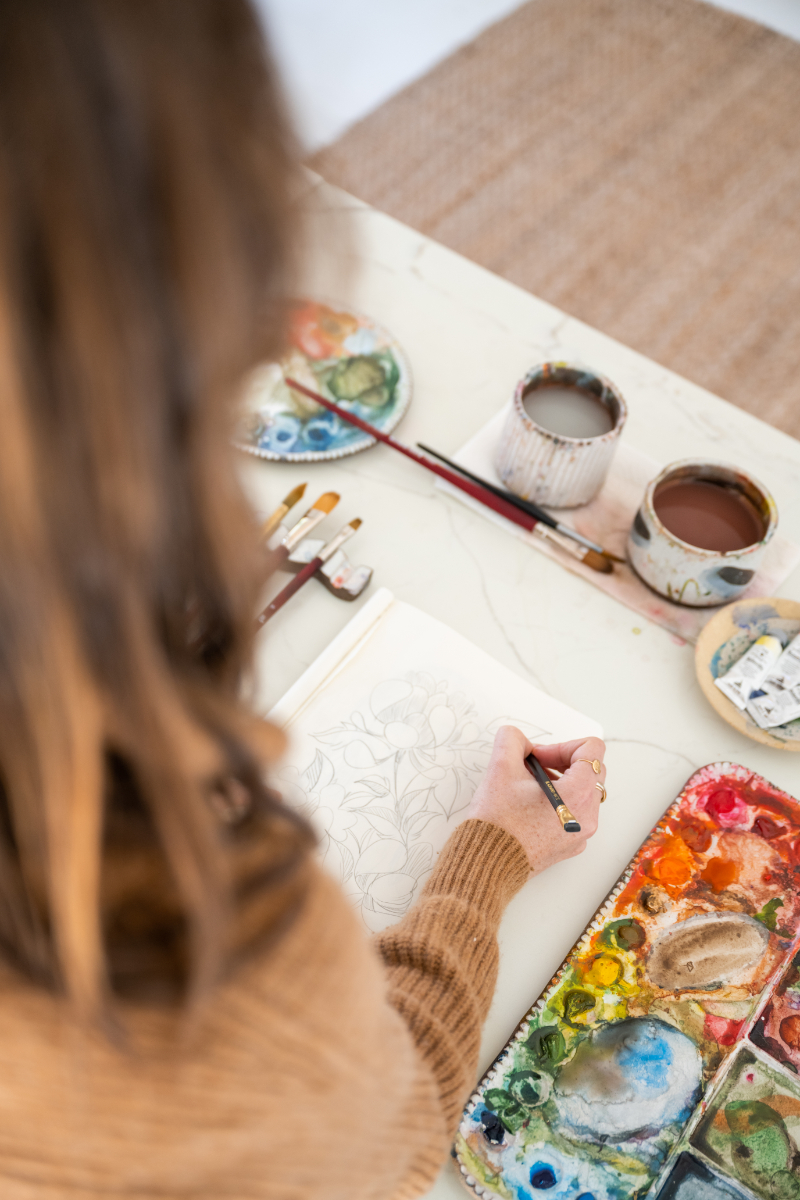
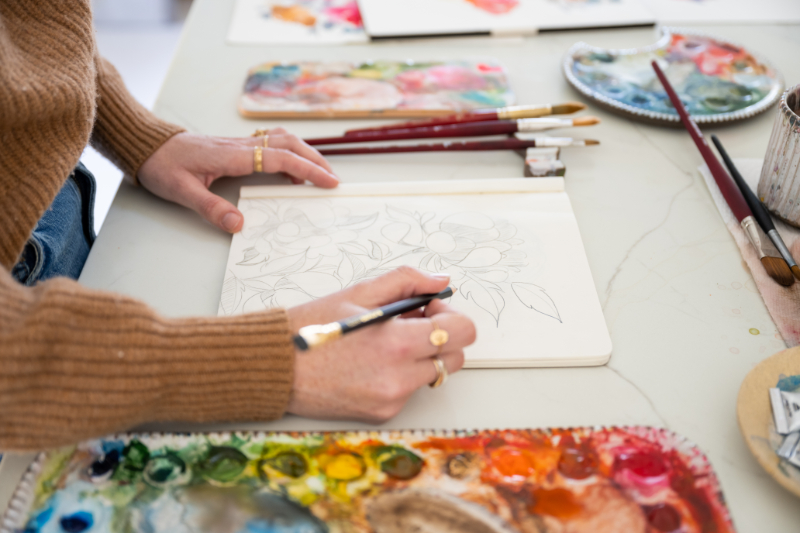
- Sketchbook or watercolor block: Cold-press paper, 5×7 or 8×10. I recommend a watercolor block. It's glued on all four sides, which means no taping and pages stay flat even with a lot of water. My Everyday Watercolor Sketchbook was built specifically for this kind of use.
- Travel palette: Pan sets are ideal for travel. Compact, no spilling, and ready to go the second you open them. I squeeze my 20 Maimeri colors into a travel palette and let them dry. For a full breakdown of pan vs. tube paints and which brands I actually use, check out my favorites page and The Ultimate Guide to the Best Watercolor Paint.
- Brushes: One or two, maximum. A medium round is my go-to, and optionally a flat for bigger washes. Travel brushes with caps protect the bristles. I bring mine in the bamboo roll-up brush holder I took to France. You can find it here! And I talk more about it in my Top 5 Must-Have Art Tools post.
- White gouache: Worth adding to your kit, especially if you're heading somewhere tropical or lush. It lets you add light details back over dark areas. Things like vein lines on leaves or highlights on water (I'll get into why more below.)
- Water container: A small collapsible silicone cup, or even a water bottle cap in a pinch.
- Pencil and eraser: Light sketching before paint. Nothing fancy needed.
- Paper towel or cloth: Always. Non-negotiable.
What to leave home:
- Your full studio palette (unnecessary weight, unnecessary pressure)
- Perfectionism (takes up too much space and ruins everything)
For more detail on building a full kit from scratch, Watercolor Supplies 101 has everything you need.

How to Set Up Your Travel Journal
Before you leave, choose your sketchbook intentionally and label it with the trip and year.
My approach is to dedicate each page to one moment, not one masterpiece. A 15-minute sketch of the view from your morning coffee spot is as valid as a detailed landscape. The point is to record what it felt like to be there, not to produce something frameable.
Leave space alongside your paintings for notes. What you were eating, what the light was doing, what you were thinking. A watercolor travel journal is part sketchbook, part diary. The words make the paintings better later.
One tip that makes a real difference: do one or two warmup sketches before you travel. Paint something from your own neighborhood first. It loosens your hand and gets your kit dialed in before you're trying to figure it out somewhere new.
And don't wait until you feel “ready” to start. Paint on the plane, at the airport coffee shop, at the hotel table. The earlier you start, the better your whole journal gets.
What to Paint: Travel Subjects by Destination
Here's how to approach the most common types of summer travel destinations, with tutorials to follow for each one.
The Beach and Coast
Perfect for loose, breezy brushwork. The goal is sky, water, and light (not every grain of sand).
What to paint: the horizon line, the way light hits the water, a single wave, wet sand reflecting the sky, a beach chair, a sun umbrella, distant figures in the surf.
How to approach it: keep it loose. Wet-on-wet for the sky and water. A few confident strokes beat a hundred fussy ones every single time. For a Matisse-inspired take on exactly this kind of beach scene, follow along with my Loose-Style Beach Scene tutorial. And if you want to work specifically on painting water, How to Paint Water in Watercolorcovers the mechanics in detail.

Villages, Architecture, and Countryside
Rolling hills, stone houses, terracotta rooftops, winding roads… The classic travel painting subject, and a lot less intimidating than it looks.
What to paint: don't try to paint the whole village. Pick one doorway, one rooftop view, one street corner. Simplify architecture into basic shapes like rectangles and triangles. A few loose tree shapes are enough context.
How to approach it: light wash for the walls, darker wet-on-dry for shadows and windows. The trick is not overworking the details. My Watercolor Italian Countryside tutorial is directly inspired by the Tuscany retreat and walks through this Matisse-style approach step by step. It works just as well for Spanish villages, Moroccan medinas, or French farmhouses as it does for Tuscany.

Tropical and Lush Landscapes
Hawaii, Mexico, the Caribbean… big leaves, bright colors, heat you can feel.
What to paint: dramatic foliage shapes, deep greens against bright sky, a single palm silhouette, a hibiscus, a dragon fruit at a market stall.
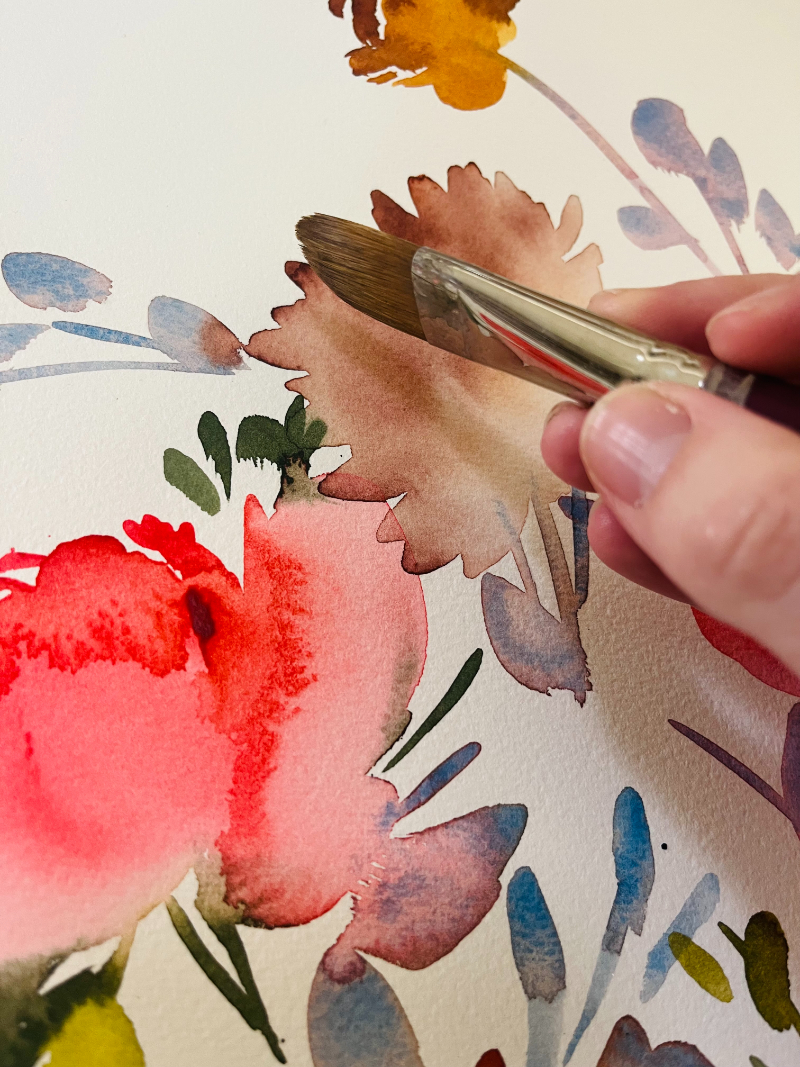
How to approach it: this is where white gouache earns its place in your kit. Watercolor alone can't easily bring light details back once you've laid down dark paint. Gouache lets you add vein lines on big tropical leaves, highlights on petals, and bright stems over darker backgrounds. My Tropical Leaves, Flowers, and Fruit tutorial covers palm trees, hibiscus, bird of paradise, dragon fruit, and walks through exactly how to use gouache alongside watercolor.
Mountains and Lakes
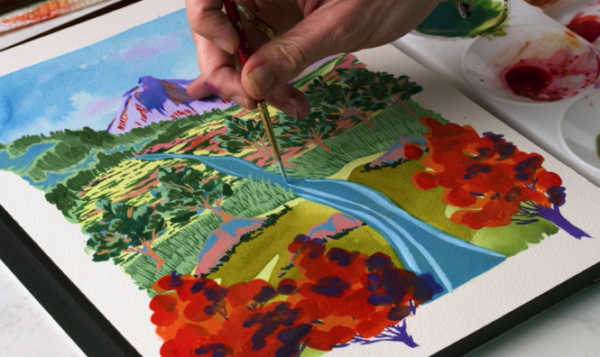
National parks, alpine lakes, camping trips… big skies, still water, quiet grandeur.
What to paint: the reflection in the lake (always worth it), mountain silhouettes, a treeline at dusk, cloud shadows on a hillside.
How to approach it: use the horizon line as your anchor. Mountain shapes are simple geometric forms, don't overcomplicate them. Wet-on-wet for the sky and lake reflections, wet-on-dry for tree details. My Mountain Lake Landscape tutorial walks through this scene step by step, and my Favorite Scenery Tutorials roundup has more options if mountains aren't your specific destination.
Sunsets (Anywhere)
Every location has a different sunset. Every sunset is worth painting.
What to paint: the color gradient from deep orange to pale peach to soft lavender. Sky, horizon, silhouette. Less is almost always more.
How to approach it: wet the entire sky first, then drop colors from top to bottom while the paper is still damp and let them bleed into each other. Add a dark silhouette at the very end, once the sky is completely dry. Read Painting Watercolor Light to Dark for the foundational rule that makes sunset paintings work, and Wet-on-Wet Technique for the core method behind that soft sky blending.
Tips for Painting on the Go
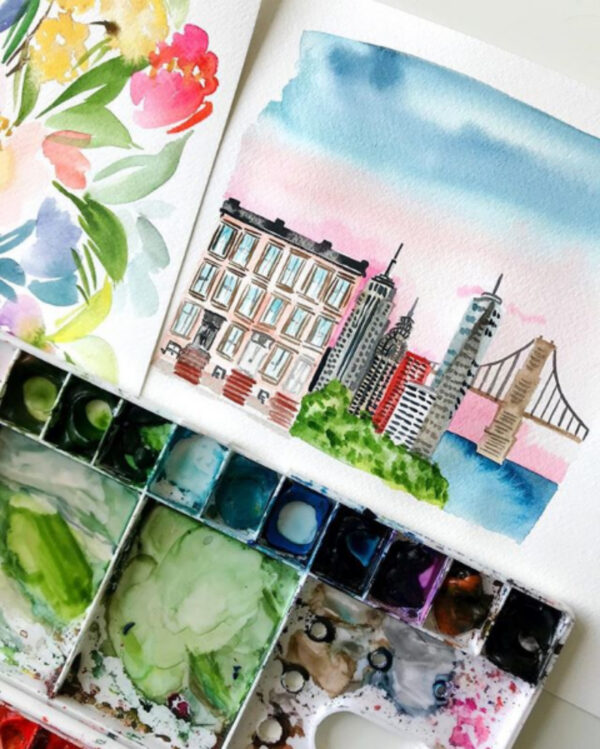
- Paint fast and loose. Time pressure pushes you toward the confident, decisive strokes that make travel journal paintings look alive.
- Reference photos are your friend. Snap a photo first, then paint from it later at the hotel or airport if you don't have time in the moment. I do this regularly. It means you never miss a subject just because the timing doesn't work. For more on taking useful reference photos and staying observant while you travel, see Finding Artistic Inspiration.
- Embrace the imperfect page. Wobbly lines, colors that bled too far, a building that's slightly off, this is the charm of a travel journal. It looks lived in. That's the whole point.
- Paint what feels significant, not what looks impressive. Your crooked little gelato sketch might be more meaningful than a technically polished Roman skyline. The small, specific moments are what make a journal yours.
- Let people watch. It almost always turns into a conversation, which almost always turns into a story. Painting in public while traveling is one of the fastest ways to connect with strangers. Take that for what it's worth.
For more on the outdoor painting mindset and what to do when you feel stuck on location, my Let the Outdoors Be Your Muse post covers all of it.
If you're newer to watercolor and want a solid foundation before you travel with your kit, my Everyday Watercolor Companion Course is the video sidekick to my book series, it covers everything from flowers to landscapes to sea life.
When You Get Home: What to Do With Your Travel Paintings
Don't shove the sketchbook in a drawer.
Leave it out where you'll flip through it. Put it on the coffee table. Let it sit on your desk. The whole point of keeping a watercolor travel journal is that it becomes something you actually return to.
Photograph your favorites and share them. Even imperfect travel sketches resonate deeply with people online, because the story behind a painting matters as much as the painting itself.
If you want to turn your best travel paintings into prints, cards, or gifts, my free class on how to scan and digitize your artwork walks you through the whole process. The equipment, the editing,all of it.
And if traveling with your sketchbook made you want a fully guided version of this experience (one where every detail is taken care of and you just show up and paint), that's exactly what my art retreats are. We've painted in France (twice), Morocco, Spain, Italy, and Portugal. Registration for the France 2027 retreat is open now. Read more about what these trips actually look like over here.
You're More Ready Than You Think
Watercolor was practically made for travel. It's portable, it's forgiving, and it slows you down in exactly the right way.
Whether you're heading to Tuscany or your nearest state park, a sketchbook in your bag changes how you move through a place. And you notice things you'd walk right past.
If you're just getting started, grab my free Complete Beginner's Guide to Watercolor e-book. It's 40 pages covering supplies, techniques, color theory, and everything you need to feel confident with a brush in hand. Pick up my Everyday Watercolor Sketchbook if you want a dedicated travel journal with QR-linked video tutorials built right in. And if you're dreaming of a fully guided travel painting experience, come check out the art retreats.
Now go pack your brushes. There's something worth painting wherever you're going.









+ show Comments
- Hide Comments
add a comment